
Table of Contents
ToggleThe Black Rose stands as one of League of Legends’ most intriguing factions, a secret assassin organization rooted deep in Noxian politics and steeped in shadow. Whether you’re drawn to the lore, fascinated by the champions who serve this dark order, or trying to understand how Black Rose members impact competitive play, this faction deserves your attention. From Talon’s calculated strikes to LeBlanc’s masterful deception, the Black Rose represents some of the most complex and mechanically rewarding champions in the game. This guide dives into everything you need to know about the Black Rose in League of Legends, covering the organization’s history, its key members, thematic elements, and how these champions function in today’s meta.
Key Takeaways
- The Black Rose is a secret Noxian assassin faction that operates through precision, manipulation, and covert elimination rather than military might, making it the shadow hand of Noxian power structures.
- Black Rose champions including Talon, Katarina, LeBlanc, Swain, and Elise each fill distinct roles and meta positions, with professional teams regularly selecting them when compositions align with their strengths.
- The black rose symbolism represents rarity, danger, and refined sophistication—these champions embody lethal grace and calculated skill rather than crude brutality, reinforced through dark purple and black visual identity.
- Black Rose champions reward mastery and coordination, maintaining 45-52% win rates in professional play substantially higher than solo queue, reflecting how organized teamplay amplifies their effectiveness.
- Internal tensions within the Black Rose—particularly between Katarina’s inherited status and Talon’s ambition, plus LeBlanc’s mysterious motivations—suggest the faction’s unified front may fracture in future lore developments.
- Competitive relevance fluctuates with patch cycles, but Black Rose members remain strategically valuable through synergies with engage tools, CC amplification, and team compositions emphasizing their burst, control, or sustainability strengths.
What Is the Black Rose in League of Legends?
The Black Rose is a secret assassin order operating within Noxus, serving as the shadow hand of those in power. Unlike Noxus’s military might, the Black Rose operates through secrecy, manipulation, and precise elimination. It’s essentially a network of elite assassins and schemers who view themselves as above common morality, they’re tools of influence, not honor.
At its core, the Black Rose exists to serve Noxian interests through covert means. Members are bound by loyalty to the organization rather than traditional Noxian military structure. The organization values skill, cunning, and unwavering dedication. Those who serve understand that the Black Rose demands everything: absolute loyalty, willingness to eliminate targets without question, and the ability to operate in complete darkness without recognition.
What makes the Black Rose unique compared to other Noxian factions is its focus on precision and shadow work. While Noxian soldiers march openly into battle, Black Rose operatives work through manipulation, assassination, and psychological warfare. The organization represents the sophisticated, calculated side of Noxian imperialism, the methods that don’t require armies, just a single blade in the right place at the right time.
Black Rose Champions and Champions Associated With the Faction
The Black Rose claims some of League‘s most mechanically demanding and thematically rich champions. Each member brings a distinct playstyle and role to the organization, from burst-focused assassins to control mages.
Talon: The Blade’s Shadow
Talon is the quintessential Black Rose assassin, a master of parkour and blade work who specializes in early game dominance and roaming. Playing Talon means leveraging his ability to scale walls, execute high-damage combos, and control side lanes with terrifying efficiency.
Key strengths include his exceptional mobility across the map, allowing him to rotate to vulnerable lanes faster than most champions. His Noxian Diplomacy passive grants a guaranteed critical strike every few hits, amplifying his burst potential. In the current meta, Talon thrives in extended lane phases where he can generate leads through roaming and teamfight participation.
His weakness comes from reliability issues at higher levels of play, good warding and map awareness can significantly limit his roaming impact. Against champions with defensive tools like Lulu or Janna, Talon’s all-in playstyle becomes riskier.
Katarina: The Sinister Blade
Katarina represents the Black Rose’s middle lane presence, functioning as a high-risk, high-reward engage carry. Her identity centers on resetting cooldowns through kills and assists, turning teamfights into cascading advantage if her team moves correctly.
Her Vorpal Blade and Sinister Blade abilities form the foundation of her damage, with most combos revolving around landing Shunpo (her blink) into enemies followed by immediate ability chains. Katarina’s strength lies in her AoE damage output and ability to clean up teamfights when opponents are grouped.
The tradeoff is positioning vulnerability, Katarina lacks defensive tools, making her susceptible to crowd control and burst from enemy assassins. A well-placed Lissandra root or Nautilus hook can end her run instantly. Success with Katarina demands excellent map awareness and timing.
LeBlanc: The Deceiver
LeBlanc is the Black Rose’s premier control mage and arguably its most complex member. Her kit revolves around deception and adaptability, she can burst single targets, deal AoE damage, and escape danger through multiple blink options.
LeBlanc’s Mirror Image passive and Distortion create layers of utility uncommon for burst mages. Her ability to combo efficiently while maintaining escape routes makes her one of the safest mages in the game. Against melee matchups, LeBlanc can consistently kite and deny pressure while farming safely.
Her tradeoff comes from mana constraints early game and reduced teamfight impact compared to other AoE mages like Orianna or Syndra. LeBlanc requires precision and excellent macro play to convert her laning advantages into wins.
Swain: The Noxian General and Founder
Swain commands both the Black Rose and considerable military authority within Noxus, he’s less assassin and more strategic mastermind. His playstyle emphasizes control, crowd control, and team coordination through sustained damage and battlefield presence.
Swain’s Ravenous Flock passive grants healing and sustain, making him exceptionally difficult to duel. His Nevermove root and Dread AoE control abilities enable him to dictate teamfight spacing. In team environments, Swain functions as a primary engage tool and damage source.
The weakness is limited single-target burst compared to pure assassins. Against mobile carries with escape tools, Swain can struggle to convert advantages. His power comes from control and sustained damage rather than eliminating targets instantly.
Elise: The Spider Queen
Elise brings flexible engagement and strategic versatility to the Black Rose, particularly through her Elise forms, she transforms between human and spider stances to adapt to situations. Her human form emphasizes range and control: her spider form emphasizes mobility and melee damage.
As a jungler, Elise excels at level-dependent spikes and early-game pathing. Her Cocoon stun provides crucial setup for teammates, while her Rappel enables vertical mobility through jungle terrain. Elise peaks during early-to-mid game stages where her CC and damage amplification turn fights decisively.
Late-game scaling becomes a concern as she falls off compared to sustained damage dealers. Her effectiveness hinges on snowballing early advantages before enemies scale, a luxury not always available in solo queue.
Lore and History of the Black Rose
Origins and Founding
The Black Rose wasn’t always a formalized organization. Its origins trace to Swain’s rise within Noxus, where he recognized that military might alone wasn’t sufficient for lasting power. True control required influence in the shadows, operatives capable of eliminating threats without leaving evidence, manipulating enemies into destroying each other, and advancing Noxian interests through means the public would never know.
Swain established the Black Rose as a counterbalance to the military’s brutality. While generals sent soldiers to die, the Black Rose ensured strategic objectives were met with surgical precision. The organization attracted the most skilled assassins, schemers, and spies available, those who valued effectiveness over glory.
Each member was carefully selected. Talon was brought in for his exceptional combat ability and street-level perspective. Katarina inherited her position through her father, making the Black Rose partially a dynastic arrangement. LeBlanc joined through mysterious circumstances, her true motivations remaining unclear even to other members. Elise was recruited for her unique supernatural abilities and willingness to operate without moral constraint.
Role in Noxian Politics
The Black Rose functions as the invisible pillar supporting Noxian power structures. While the military handles external threats and expansion, the Black Rose manages internal politics, eliminates inconvenient rivals, and ensures loyalty through fear and incentive.
Swain uses the organization strategically, it’s his insurance policy against coups, his tool for gathering intelligence, and his method for eliminating obstacles to his vision of Noxia. Unlike typical secret police forces that serve dictators, the Black Rose operates with some autonomy. Members understand they’re serving Noxia’s long-term interests, not just one leader’s whims, though that distinction sometimes blurs.
The relationship between the Black Rose and Noxius military hierarchy is complex. Some generals respect the organization’s efficiency: others view it with suspicion. This tension creates narrative depth, the Black Rose must maintain loyalty while operating independently enough to be effective.
Recent Story Developments and Cinematic Appearances
Recent League of Legends cinematics have highlighted the Black Rose prominently, particularly in narrative arcs focused on Noxian internal conflict. Swain’s continued dominance signals the Black Rose’s security, but tensions emerge periodically.
Katarina and Talon’s relationship adds interpersonal complexity, they’re both highly skilled, both ambitious, and both answer to the same organization. Their interactions in stories and interactions hint at deeper political jockeying within Black Rose ranks. Will Talon eventually challenge Katarina’s inheritance-based status? Will LeBlanc’s mysterious motivations eventually diverge from the organization’s objectives?
The most recent developments suggest the Black Rose may face existential challenges from other Noxian factions gaining power. Darius and his military sphere represent a competing power base, creating potential for internal Noxian conflict that could fracture the Black Rose’s unified front. This narrative tension ensures the faction remains thematically relevant even though being introduced years ago.
Black Rose Thematic Elements and Symbolism
The Flower Symbolism
The black rose isn’t a naturally occurring flower, it’s a symbol of rarity, danger, and forbidden beauty. In literature and historical tradition, black roses represent death, darkness, and mystery. The League of Legends Black Rose organization leans heavily into this symbolism: rare, deadly, and beautiful in a dangerous, unsettling way.
Champions associated with the Black Rose embody this duality. Katarina moves with lethal grace, her daggers flowing like deadly petals. Talon’s parkour mechanics evoke a kind of beautiful, precise violence. LeBlanc’s deceptions are elegant mind games wrapped in danger. The black rose symbolizes that these assassins aren’t crude, brutal tools, they’re refined instruments of death, operating at the highest levels of skill and sophistication.
The symbolism extends to the organization’s philosophy. A black rose must be cultivated carefully, grown in conditions others can’t replicate. Similarly, Black Rose operatives are developed through rigorous training and selection. They’re rare because creating a skilled assassin demands more than weapons, it demands discipline, cunning, and willingness to embrace darkness.
Color Scheme and Visual Identity
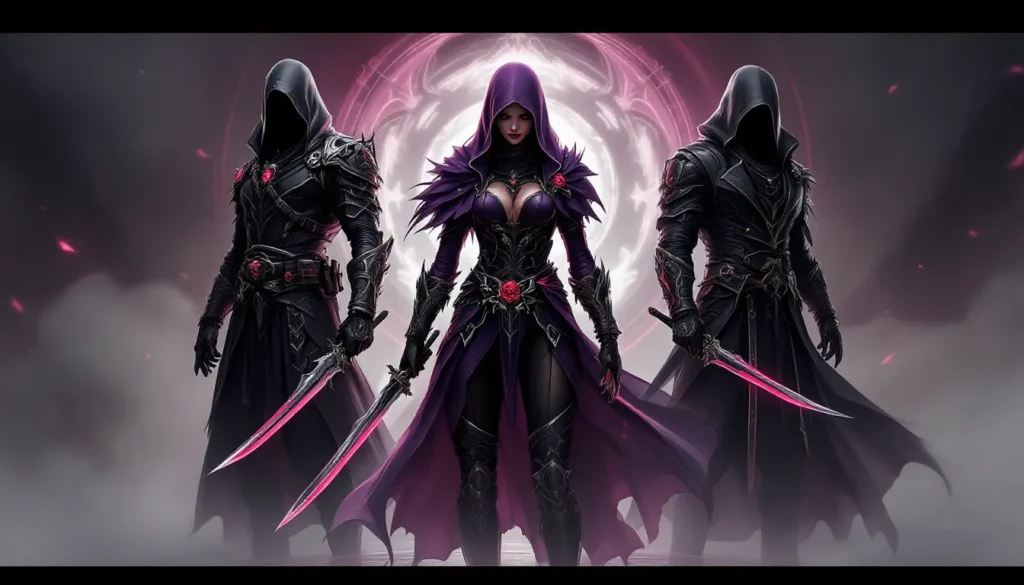
The Black Rose’s visual identity relies on dark purples, deep blacks, and occasional crimson red accents, colors associated with Noxus but distinctly more subdued than the military’s aggressive reds. This color palette communicates that the Black Rose operates in shadow rather than sunlight.
In champion designs, these colors appear consistently. Talon’s dark clothing and sharp visual design evoke precision and danger. Katarina’s purple and red costume blends Noxian heritage with assassin mystique. LeBlanc’s ethereal, dark aesthetic communicates otherworldly deception. Swain’s darker tones compared to typical Noxian generals reinforce his status as a shadow power.
The visual language extends to spell effects and animations. Black Rose abilities often feature purple or dark energy rather than Noxia’s typical aggressive red. This creates a visual distinction between military Noxians and shadow operatives, reinforcing their different operational philosophies.
How the Black Rose Impacts Competitive League Play
Meta Relevance of Black Rose Champions
Black Rose champions occupy different roles and meta positions depending on patch cycles and item changes. As of 2026, the competitive landscape continues to evolve, but certain patterns emerge consistently.
Talon thrives in early-game focused compositions where teams prioritize roaming and multi-threat engagement. Competitive teams often pick Talon into control-heavy matchups where his mobility and rotation speed provide advantages. His presence in professional play spikes significantly during patches favoring AD mid-lane champions and lethality items. Current patch shifts toward bruiser items have reduced his pure burst potential somewhat, making him less prevalent than during lethality-heavy metas.
Katarina remains a niche competitive pick, selected primarily for specific matchups or team compositions requiring significant AoE threat. Professional teams generally prefer more reliable champions, but Katarina appears occasionally in high-level play when teams build compositions enabling her strengths. Her pick rate increases in patches where AP mythic items provide sufficient damage, though item changes often shift her viability unpredictably.
LeBlanc maintains more consistent competitive presence compared to Katarina, functioning as a reliable control mage with burst potential. Professional leagues regularly feature LeBlanc when meta shifts favor control mages over early-game aggressors. Her ability to scale while remaining effective in early-to-mid game skirmishes makes her valuable in macro-focused competition.
Swain operates as a contextual pick, he appears in compositions requiring frontline presence and sustained AoE damage. His effectiveness correlates strongly with item changes and opposing team composition. When enemy compositions stack melee threats or when AP items provide sufficient damage, Swain becomes significantly more attractive to professional teams.
Elise experiences feast-or-famine competitiveness depending on jungle meta. When early-game junglers dictate pace, she appears frequently. When scaling or sustained damage junglers dominate, her appearances drop. Professional teams value her flexibility and CC, making her a consistent alternative pick in meta-diverse championships.
According to League of Legends Esports, analyzing champion performance across professional leagues reveals that assassins and control mages generally maintain 45-52% win rates in coordinated environments, substantially higher than solo queue. This gap reflects how Black Rose champions reward organization and coordination, skills professional teams develop extensively.
Synergies and Team Composition Considerations
Black Rose champions function best within team compositions emphasizing their strengths. Talon pairs excellently with champions requiring reliable engage setups, ADCs like Kai’Sa or Jinx benefit from Talon’s disruption creating windows to position aggressively. Support champions with CC amplification like Thresh enable Talon’s burst to convert into team kills.
Katarina demands compositions providing engage or setup. Champions like Orianna or Malzahar create guaranteed team fight initiations that Katarina’s resets can capitalize on. Her success depends on teammates ensuring fights occur when her cooldowns are available, otherwise she’s a high-value target without activation.
LeBlanc slots well into control-oriented compositions where the team prioritizes consistent damage output. She pairs naturally with supports like Lissandra or Lulu who provide additional control or protection. LeBlanc’s self-sufficiency means she doesn’t require excessive team coordination, making her adaptable across composition types.
Swain functions as a primary engage tool requiring follow-up damage. Teams picking Swain typically build around his strengths, additional AoE damage through champions like Cassiopeia or sustained follow-up from ADCs like Ashe. His crowd control demands teammates positioned to convert into kills rather than waste his setup.
Elise in jungle requires coordinated pathing and gank timing with laners. Champions enabling her roams, those with wave clear and safety, maximize Elise’s impact. Top laners like Ornn or Malphite provide additional engage synergy with her CC, creating unavoidable teamfight scenarios.
Black Rose in League of Legends Skin Lines and Cosmetics
Riot Games has capitalized on the Black Rose faction’s popularity through exclusive skin lines featuring its members. These cosmetics extend the faction’s visual identity and provide mechanical or thematic variations that enhance player expression.
The Project skin line is the most obvious thematic extension, featuring futuristic interpretations of Black Rose champions. Talon, Katarina, and other members received interpretations as sleek cyber-assassins. These skins maintain the faction’s core identity, precision, danger, sophistication, while updating aesthetics to a sci-fi setting.
High Noon and Spirit Blossom skin lines have also featured Black Rose members, adapting the faction’s themes to Western and mystical aesthetics respectively. Riot’s approach emphasizes that the Black Rose’s core identity transcends specific settings, whether in Noxia, cyber-futures, or alternate dimensions, these assassins maintain their essence.
Prestige skin variants signal champion status within the Black Rose hierarchy. Limited-edition, ultra-exclusive cosmetics reinforce that the organization’s members represent the absolute elite. Players purchasing these skins participate in the fantasy of joining an elite organization inaccessible to ordinary soldiers.
Skin lines generate revenue while deepening lore engagement. A player purchasing a Project Talon skin isn’t just buying a cosmetic, they’re participating in expanded universe storytelling. This cross-promotion between gameplay and cosmetics creates ongoing engagement with the faction, ensuring the Black Rose remains relevant years after initial introduction.
On Mobalytics, players can browse competitive guides specific to Black Rose champions, with many guides featuring skin-specific ability effect information relevant to competitive play clarity. While cosmetics don’t affect mechanical functionality, visual clarity remains important for high-level gameplay.
Connection to Other Noxian Factions and Regions
The Black Rose doesn’t exist in isolation, it’s woven into Noxian political fabric alongside competing power bases. Understanding these relationships provides crucial context for the faction’s ongoing narrative relevance.
The Noxian Military represents the most obvious counterbalance. Darius, Draven, and their supporters embody Noxia’s martial tradition, direct, honorable in their own way, and focused on external conquest. The Black Rose operates differently: subtle, deceptive, and focused on internal power consolidation. This philosophical divide creates constant tension. Military generals resent the Black Rose’s perceived superiority, while Black Rose members view the military as crude instruments.
Darkwill’s Regime created the original conditions for the Black Rose’s rise. Under the tyrannical leader, Swain recognized that organized assassination capacity would become invaluable for survival and advancement. The organization formed partially as response to Darkwill’s despotism, though Swain’s motivations remain murky. Darkwill’s eventual assassination represented Black Rose’s coming-of-age as a functional political tool.
The relationship between the Black Rose and Swain himself deserves scrutiny. Is the organization truly autonomous, or does it function as Swain’s personal instrument? Lore suggests Swain views the Black Rose as his, but he’s also aware that absolute control breeds complacency. Allowing members like Talon and LeBlanc operational independence ensures organizational vitality and prevents groupthink.
Connections to other Noxian regions vary. Some Black Rose operatives maintain deep connections to Noxian street culture, like Talon’s backstory, while others, like LeBlanc, operate almost entirely outside traditional Noxian hierarchy. This diversity makes the Black Rose functionally independent from regional politics while maintaining strategic alignment with Noxian expansion goals.
The Black Rose and Zaun connection remains largely unexplored but tantalizing. Some speculation suggests Black Rose operatives recruit from Zaun, leveraging its assassination tradition and moral flexibility. If true, this would represent significant intelligence and operational capability sourced from outside traditional Noxian structures, essentially Swain building a parallel power base immune to traditional military politics.
Recent lore developments hint that the Sinister Blade (Katarina) may be positioning for increased independence or even leadership challenge to Swain. If true, the Black Rose’s unified front could fracture, fundamentally altering Noxian political dynamics. Such narrative tension ensures the faction remains compelling even though established hierarchy.
Conclusion
The Black Rose represents League of Legends’ most sophisticated faction, an organization where lore depth matches mechanical complexity. Whether you’re fascinated by narrative intricacy, competitive implications, or champion design, the Black Rose delivers on all fronts.
From Talon’s early-game roaming dominance to LeBlanc’s control-focused deception, these champions reward mastery and punish carelessness. Their thematic coherence, the black rose symbolism, shadow operations, and moral ambiguity, elevates them beyond typical assassins into characters worth understanding deeply.
Competitively, Black Rose champions remain meta-relevant through patch cycles, with professional teams regularly featuring them in coordinated environments. Casual players find them rewarding to master, requiring mechanical precision and strategic awareness. The faction’s cosmetics and lore expansions ensure ongoing engagement from story enthusiasts.
As League’s narrative continues evolving, the Black Rose’s future remains compelling. Will Katarina eventually challenge Swain? Will LeBlanc’s mysterious agenda eventually diverge from organizational goals? How will the Black Rose adapt as other Noxian power bases grow stronger? These questions keep the faction fresh and narratively significant.
For players seeking to understand League’s political landscape, master assassin champions, or simply appreciate sophisticated character design and lore, the Black Rose offers endless depth. This faction exemplifies why League of Legends transcends being merely a game, it’s a universe where every faction, every champion, and every story intersection carries weight and meaning. The Black Rose remains a testament to that complexity, continuing to captivate new players while rewarding longtime fans exploring its layered history and ongoing evolution.


