
Table of Contents
ToggleViktor’s journey from the Undercity to the world stage has been nothing short of legendary. Originally introduced in League of Legends as the Machine Herald, Viktor captured players’ imagination with his cybernetic upgrades and apocalyptic vision. But when Arcane brought him to life on screen, something shifted, suddenly, this champion wasn’t just pixels and patch notes. He became a fully realized character with motivations, struggles, and a philosophy that challenged everything Runeterra stood for. If you’re wondering how the game’s version of Viktor compares to Arcane’s portrayal, or you’re just curious about what makes this character resonate with millions of fans, you’re in the right place. We’re breaking down Viktor’s evolution across both mediums, his role in Arcane’s narrative, and why he matters more than ever heading into 2026.
Key Takeaways
- Viktor’s transformation in Arcane presents him as a sympathetic young scientist facing mortality, gradually augmenting his body throughout the series rather than appearing as a fully realized cyborg like his League of Legends counterpart.
- Viktor’s ideology centers on eliminating human imperfection through mandatory hextech augmentation, a totalitarian vision of progress masked as liberation that escalates throughout Arcane’s narrative.
- The contrast between Jayce’s institutional approach and Viktor’s revolutionary philosophy creates the central ideological conflict driving Arcane’s tension between Piltover and Zaun.
- Arcane’s portrayal transformed Viktor from an interesting champion mechanic into an iconic League of Legends character, increasing his competitive viability and inspiring renewed player engagement in professional play.
- Viktor’s vision for change destabilizes existing power structures in Zaun while forcing other characters into increasingly difficult moral positions, creating chaos despite his pursuit of perfect order.
- The show reveals Viktor’s tragedy lies not in being wrong about hextech’s potential, but in his inability to accept that chosen imperfection might hold human value.
Who Is Viktor? A Champion’s Journey From Game to Screen
Viktor stands as one of League of Legends’ most compelling champions, a character whose design philosophy centers on technological advancement and self-improvement through hextech augmentation. Since his 2011 release, Viktor has evolved from a niche pick into a staple of competitive play and casual gaming alike. His presence in Arcane marks a significant moment for the champion, a chance to show audiences why players have gravitated toward him for over a decade.
Viktor’s Role in League of Legends Lore
Within Runeterra’s expansive universe, Viktor occupies a unique position as an idealist turned revolutionary. He envisions a world where humanity transcends its biological limitations through hextech evolution, believing that perfection isn’t a destination but an endless journey of improvement. This philosophy directly conflicts with Piltover’s established order and Zaun’s desperate struggle for survival. Unlike champions driven by revenge or power for its own sake, Viktor’s motivation stems from a genuine, if misguided, desire to elevate all of humanity.
In the League lore, Viktor operates from Zaun’s underground, where he’s become a symbol of hope for the underprivileged. The disparity between Piltover’s gleaming architecture and Zaun’s industrial decay fuels his conviction that hextech augmentation offers the only path to equality. His character explores themes of technological salvation, the cost of progress, and whether evolution can be achieved without losing one’s humanity.
The Champion’s Original Backstory and Design
Viktor wasn’t always the cyborg we see today. His original lore painted him as a brilliant Zaunite inventor who suffered a terrible accident in his workshop. The injury forced him to make a choice: accept his limitations or augment himself. He chose augmentation, embedding hextech directly into his body to not only survive but to become something more. This origin story perfectly encapsulates his core philosophy, weakness is a problem that can be engineered away.
From a design perspective, Viktor’s kit reflects his thematic identity. His abilities focus on area control, zone denial, and persistent threats rather than burst damage. The Hexcore, his signature item in-game, represents his constant pursuit of upgrades, players literally enhance Viktor’s abilities as the match progresses. This mechanic gives him a unique power curve that rewards scaling and long-term planning, much like his philosophical vision requires time and patience to realize. When Arcane adapted Viktor, the show’s creators leveraged this foundational design to inform how they portrayed his character arc, maintaining thematic consistency while expanding his emotional depth.
Viktor’s Appearance and Character Arc in Arcane
Arcane’s iteration of Viktor presents a character at a crossroads, forced to confront the human cost of his ambitions far earlier than his League lore counterpart. The show strips away the comfortable certainty of his game persona, replacing it with genuine vulnerability and moral complexity.
Casting and Character Design in the Series
Steady Haggard voices Viktor in Arcane, bringing a measured, intellectual quality to the character that underscores his scientist persona. The vocal performance captures Viktor’s inherent decency, he’s not a villain shouting about domination, but a young man grappling with impossible circumstances. Visually, Arcane’s designers crafted a Viktor who begins the series relatively unaugmented, showing clear progression as his body fails him and he’s forced to rely increasingly on hextech.
The character design in the show deliberately emphasizes his vulnerability. Early-season Viktor appears gaunt and sickly, his body visibly deteriorating from an unspecified illness, likely the same condition that drives his desperation in later seasons. Unlike the game’s fully cybernetic version, Arcane’s Viktor gradually transforms, making each augmentation feel like a meaningful choice rather than inevitable destiny. His design shift parallels his emotional journey, with armor and metal plating accumulating as his humanity seems to recede. This visual storytelling reinforces the central tension: is Viktor ascending or descending into something inhuman?
Key Moments and Story Development
Viktor’s arc in Arcane pivots on his relationship with Jayce and his growing desperation as his illness progresses. Early interactions with Jayce reveal two young inventors with competing philosophies, Jayce believes in Piltover’s innovation through proper channels, while Viktor sees hextech as Zaun’s only escape route. These philosophical differences crystallize their conflict and set the stage for Viktor’s eventual radicalization.
The turning point arrives when Viktor gains access to Powder’s (Jinx’s) hextech bomb fragment, which he recognizes as revolutionary technology. This moment represents Viktor’s crossing of a threshold, he stops waiting for institutional support and embraces his vision fully, consequences be damned. His decision to prototype his transformation in the streets of Zaun, visible to anyone watching, signals his commitment to proving hextech perfection works. By the latter episodes, Viktor emerges as a figure of both awe and terror, someone whose vision for the future demands sacrifice from everyone around him.
The Transformation: Viktor’s Hextech Evolution
Viktor’s physical transformation forms the visual and thematic core of his character arc. The progression from sickly inventor to augmented revolutionary happens gradually, forcing viewers to witness each choice and consider whether Viktor remains himself through the process.
The Upgrade System and Body Modifications
Arcane’s portrayal of Viktor’s augmentations differs significantly from the game’s immediate full-body cybernetic conversion. The show presents his modifications as gradual, starting with targeted limb replacements and evolving into more extensive internal changes. Each upgrade appears necessary at first, he needs his arm to function, his chest to survive, but the cumulative effect transforms him into something beyond human recognition.
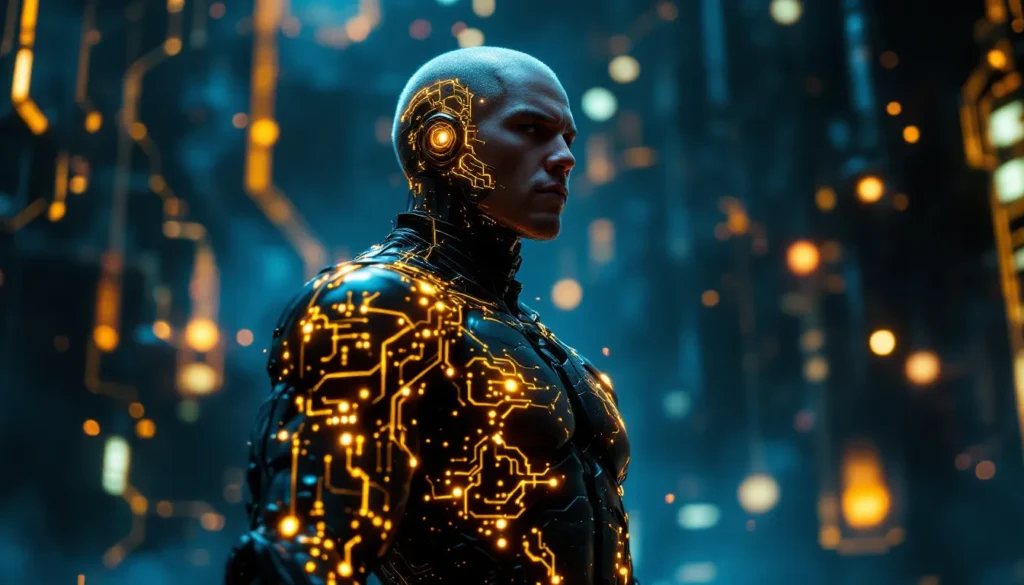
The visual design of his augmentations emphasizes biomechanical integration rather than replacement. Viktor’s hextech parts don’t look grafted onto a human body: they flow naturally as if growing from within him. This design choice matters narratively, it suggests Viktor’s enhancements aren’t external tools but fundamental alterations to his being. The golden, radiant quality of his hextech contrasts sharply with Zaun’s industrial grays and browns, making Viktor literally glow with otherworldly potential. By Act Three, Viktor has become something transcendent, his body barely recognizable as human, yet the show maintains his consciousness and agency throughout the transformation. The question lingers: has Viktor evolved beyond humanity or lost it entirely?
Viktor’s Abilities and Combat Style
Understanding Viktor’s combat mechanics in League of Legends illuminates how Arcane interprets his powers within a narrative context. The gap between game mechanics and show portrayal reveals creative choices that enhance character storytelling.
Champion Mechanics in League of Legends
In League of Legends, Viktor functions as a control mage with exceptional zone denial capabilities. His Death Ray (E) fires a laser beam that damages and slows enemies while applying his Augment effects. His Gravity Field (W) creates a slow zone that damages opponents attempting to escape, essentially cordoning off portions of the map. Most distinctively, his Ultimate Ability, Chaos Storm (R), summons a controllable storm that damages enemies and scales based on his cooldown reduction, a mechanics unique to Viktor that rewards building around ability haste.
The Hexcore, his signature passive, rewards long-term gameplay. As Viktor deals damage and kills minions, he gradually charges the Hexcore, allowing him to augment his abilities at specific breakpoints. Each augment fundamentally changes how an ability functions, Death Ray gains range, Gravity Field gains radius, and Laser gains a bonus effect. This upgrade system creates natural power spikes throughout the match and forces Viktor players to plan their itemization carefully. Currently in 2026 patches, Viktor maintains a respectable position in mid-lane meta, with competitive play on Mobalytics showing him at approximately 51% win rate in solo queue.
How Arcane Interprets His Powers
Arcane doesn’t show Viktor wielding these exact abilities, but the show’s visual language channels their essence. His Gravity Field appears when he creates zones of hextech-enhanced space that repel or damage intruders, viewers see the mechanical equivalent of the game ability manifested through environmental manipulation. His ultimate Chaos Storm manifests as moments of overwhelming hextech power that he unleashes when pushed to desperation. Rather than literal laser beams, Arcane’s Viktor weaponizes his augmented body directly, moving with unnatural precision and unleashing pulses of energy.
The narrative interpretation emphasizes Viktor’s strategic, area-control philosophy. He doesn’t engage in duels: he changes the battlefield itself to favor his vision. When Viktor acts in Arcane, he does so with the deliberation of a mage controlling space, he’s five steps ahead, creating conditions that force opponents into predetermined outcomes. This translates the game’s control mage archetype into character motivation. Viktor isn’t just powerful: he’s someone who understands systems and levers for change, making him dangerous not through raw damage but through calculated transformation.
Viktor’s Relationship With Other Characters
Viktor’s interactions with other characters in Arcane reveal both his core motivations and the isolation that comes with pursuing radical change. His relationships form the emotional anchor of his character arc.
Connections to Zaun’s Underground
Viktor’s relationship with Zaun itself operates as a character dynamic. He views the city not with resignation but with revolutionary potential, Zaun isn’t a place to escape but to transform. His connections to various Zaunite figures throughout the series range from sympathetic collaboration to uncomfortable alliance. He’s genuinely beloved by segments of Zaun’s population who see his vision as hope, yet his methods increasingly alienate those he claims to liberate.
The character operates within Zaun’s underground networks while maintaining intellectual distance from its gang structures. Unlike figures like Silco who rule through fear and control, Viktor attempts to offer salvation through progress. This distinction matters, Viktor isn’t seeking power over people: he’s pursuing transcendence for them, whether they want it or not. His most significant Zaun connections evolve as his augmentations progress, with earlier collaborators becoming confused or horrified by what he’s becoming.
Interactions With Main Arcane Cast Members
Viktor’s dynamic with Jayce defines his character arc’s central conflict. Both young inventors, they represent competing visions for how hextech should serve society. Jayce champions Piltover’s institutional approach, believing proper channels and regulations will guide hextech’s development responsibly. Viktor sees these same institutions as barriers keeping Zaun oppressed. Their rivalry isn’t personal animosity initially, it’s ideological, making their eventual confrontation feel inevitable and tragic.
Viktor’s relationship with Powder/Jinx forms another crucial thread. Her hextech bomb fragment becomes the catalyst for Viktor’s radicalization, and his interaction with her weaponization of hextech validates his theories. Unlike Jayce, who dismisses unconventional approaches, Viktor recognizes Powder’s raw potential and sees her as proof that hextech transcends institutional boundaries. This connection to Arcane’s most volatile character hints at the instability underlying Viktor’s vision.
Viktor’s connection to Caitlyn, though indirect, matters thematically. She represents Piltover law and order, everything Viktor’s philosophy challenges. Similarly, his awareness of Powder’s connection to Vi carries weight: Viktor understands that his transformation disrupts everyone’s lives. These relationships accumulate into a portrait of a character whose pursuit of perfection isolates him progressively from the human connections that originally motivated his work. Interestingly, Vi League of Legends explores similar themes of isolation and sacrifice, making the sister characters’ parallel journeys fascinating in comparison.
The Hextech Revolution: Viktor’s Vision for Change
Viktor’s ideology extends beyond personal ambition into a comprehensive vision for societal transformation. Understanding his goals illuminates the conflict driving Arcane’s central tensions.
His Goals and Ideology in the Series
Viktor fundamentally believes that imperfection, whether biological weakness, social inequality, or human limitation, can and should be engineered away. His vision proposes that universal hextech augmentation offers the path to true equality. In Zaun’s context, where poverty and desperation define existence, Viktor’s promise of transcendence carries genuine appeal. He’s not lying about the benefits: hextech augmentation demonstrably improves physical capability and quality of life.
The danger in Viktor’s ideology lies in its totalizing nature. He doesn’t envision a world where people choose augmentation: he works toward mandatory transformation. His vision of perfection doesn’t accommodate human choice, resistance, or the desire to remain “imperfect.” This represents a fundamental authoritarianism masked in the language of liberation, Viktor will perfect humanity whether humanity consents or not. The tragedy isn’t that he’s wrong about hextech’s potential: it’s that he’s willing to sacrifice individual agency to realize collective ascension.
Viktor’s rhetoric focuses on inevitability. Progress is coming, he suggests, and the only choice is whether to lead it or be swept along. This framing removes moral responsibility from his choices, he’s not choosing to transform society: he’s simply accelerating what must happen anyway. This rationalization appears repeatedly in Arcane, with Viktor justifying increasingly radical actions as necessary steps toward predetermined evolution.
Impact on Zaun and the Greater Conflict
Viktor’s transformation ripples through both the series’ immediate narrative and the larger conflict between Piltover and Zaun. His emergence as a figure of hextech mastery provides Zaun with apparent technological parity, potentially tilting power dynamics. For Zaun’s oppressed populations, Viktor represents hope, finally, someone with the knowledge and power to challenge Piltover’s dominance.
Yet his influence destabilizes Zaun’s existing power structures. Silco, who ruled through fear and control, finds his authority questioned by Viktor’s promise of transcendence. This power vacuum creates chaos even as Viktor positions himself as the solution. The irony deepens as Viktor’s pursuit of order through perfection actually creates more disorder, pushing characters like Powder further toward radicalism and violence.
On the larger stage, Viktor’s actions force Piltover into responses that accelerate conflict. Jayce’s drive to stop Viktor militarizes Piltover’s approach to Zaun, while Caitlyn becomes trapped between institutional duty and personal conscience. Viktor doesn’t merely participate in the conflict: his very existence as a transformed being forces other characters into increasingly difficult positions. His vision for change becomes self-fulfilling, pursuing perfect order, he creates perfect chaos.
Comparing Game Viktor to Arcane’s Version
The gap between League of Legends’ Viktor and Arcane’s portrayal reveals deliberate creative choices that enhance both the character and the narrative. Examining these differences illuminates what each medium prioritizes.
Narrative Differences and Adaptations
Game Viktor presents an already-completed transformation. Players encounter him as a fully realized cyborg with a clear ideology and aesthetic identity. His motivation is apparent but somewhat abstract, he wants hextech perfection and views it as inevitable progress. The game doesn’t deeply explore the human cost of transformation or Viktor’s doubts, partly because game narratives historically prioritized mechanics over character development.
Arcane’s Viktor undergoes transformation during the narrative, forcing viewers to witness each choice and its consequences. The show presents Viktor as sympathetic early on, a brilliant young scientist facing mortality, before his augmentations gradually reshape his priorities and personality. Where game Viktor is assured in his vision, Arcane’s Viktor wrestles with desperation, fear, and the creeping realization that he might be losing himself in pursuit of transcendence.
The timeline also differs significantly. Game lore places Viktor’s choices in an ambiguous past: Arcane shows them unfolding in real time. This compression creates urgency and horror that game lore, with its sprawling centuries-spanning history, lacks. Arcane’s Viktor makes irreversible choices within a matter of weeks, whereas game Viktor’s backstory suggests a more gradual process of self-modification.
Thematically, Arcane amplifies Viktor’s tragedy. Game Viktor is presented as succeeding at his vision, he becomes powerful and influential. Arcane’s Viktor succeeds too, but at a cost viewers witness directly. The show questions whether Viktor’s advancement constitutes triumph or tragedy, whereas game lore presents it more straightforwardly as progress.
Fan Reception and Community Response
The gaming community’s response to Arcane’s Viktor reveals how character adaptation can deepen appreciation for the original champion. Many players who previously viewed Viktor as an interesting but not particularly emotionally resonant character found themselves deeply invested after watching Arcane. The show’s portrayal made Viktor’s League mechanics feel more meaningful, when you understand the desperation behind the power curve and zone control, his strategic, patient playstyle gains emotional weight.
Conversely, some players felt Arcane’s Viktor strayed too far from game lore’s certainty and idealism, presenting him as more unambiguously tragic than game Viktor’s complex motivation. This divide reflects broader discussions about League lore’s direction and how expansions like Arcane should adapt existing canon. Rankings on Game8 for Viktor’s current viability show his appeal has broadened since Arcane’s release, with increased mid-lane pick rates among players driven by narrative interest.
The community consensus leans strongly positive on Arcane’s character work. Viktor became significantly more popular after the show’s release, with Ryze: The Rune Mage of League of Legends experiencing similar character depth expansion through other media. Cosplays of Arcane’s Viktor, fan art, and community discussions about his philosophy suggest the show successfully elevated his status from “interesting champion mechanic” to “iconic League character.” The adaptation proved that investing in character detail pays dividends even for established IPs with existing fan bases.
Professional play has also reflected this interest. LoL Esports broadcasts show renewed Viktor picks in competitive matches, with players explicitly citing Arcane’s portrayal as motivation for mastering the champion. This crossover between narrative engagement and competitive interest demonstrates how strong character adaptation can drive sustained engagement across a game’s player base.
Conclusion
Viktor’s evolution from League of Legends champion to Arcane icon represents something profound about how games and shows can collaborate to deepen storytelling. The Machine Herald entered 2026 as a character far richer than lines of code or even well-written lore, he’s become a symbol of progress’s double edge, ambition’s costs, and the tragedy of utopian visions pursued without consent.
What makes Viktor resonate across mediums is his fundamental sympathetic appeal. He’s not cartoonishly evil or obviously wrong about hextech’s potential. His tragedy lies in his inability to imagine a world where perfect advancement isn’t mandatory, where chosen imperfection might hold value. Arcane revealed this dimension of his character, transforming him from a concept into a person we can simultaneously understand and fear.
For League players heading into competitive seasons, Viktor remains a legitimately powerful choice whose mechanical depth matches his thematic complexity. For Arcane fans wrestling with Viktor’s philosophy, the show’s portrayal offers a character study in how ideology can consume identity. For everyone else, Viktor’s story stands as a reminder that progress without wisdom creates only sophisticated destruction. In 1152 days, Viktor’s impact on both gaming and streaming culture continues expanding, a testament to how well-executed character work transcends medium boundaries.


